In 2026, CSIC centers on the Cantoblanco campus will celebrate Europe Day at the Eugenio Trías Public Library, located in the former Casa de Fieras in El Retiro Park. This is a two-hour activity aimed at high school students. It will take place on May 6, 7, and 8 (Wednesday, Thursday, and Friday), with two sessions each day: from 9:30 to 11:30 a.m., and from 12:00 to 2:00 p.m.
As every year, the event includes a one-hour meeting with researchers working within the European framework, with the aim of showcasing the research we carry out in a European context and highlighting the opportunities that the European Union offers to participate in, promote, and fund research across various fields (biology, materials science, chemistry, physics, etc.).
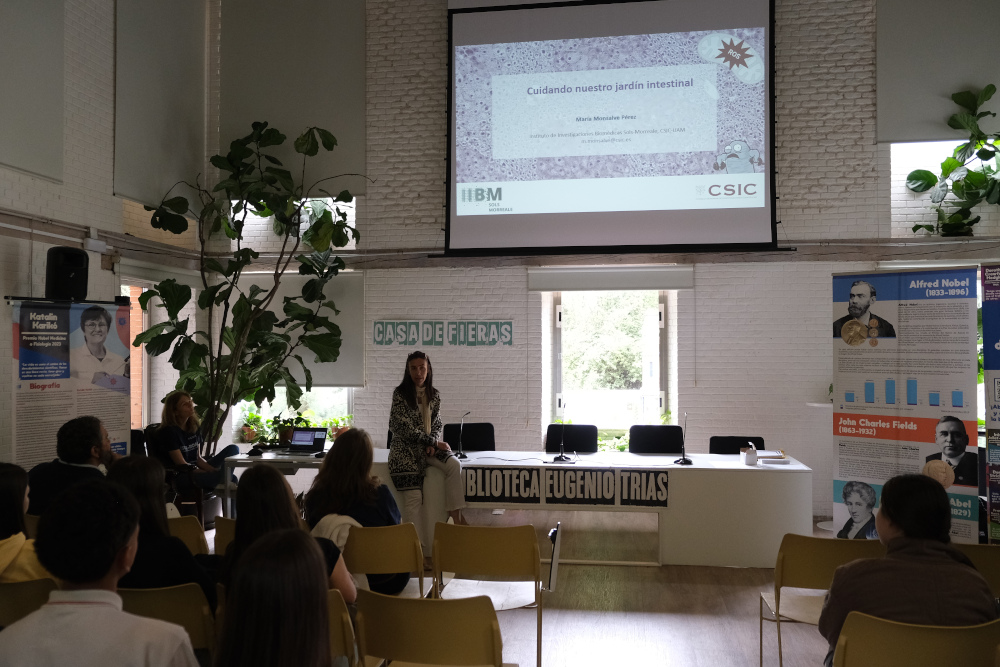
Within this initiative, the Instituto de Investigaciones Biomédicas Sols-Morreale (IIBM) will be represented on May 7 by María Monsalve, who will deliver the outreach talk “Caring for Our Intestinal Garden” to 63 students from the 1st year of Bachillerato and 4th year of ESO at Colegio SEI La Merced. María Monsalve is head of the research group “Mitochondrial Function in Health and Disease” at the IIBM. She and Ángela M. Valverde are participants in the European project (EU270756_1) HORIZON-EIC-2023-PATHFINDERCHALLENGES, funded by the European Union under the Horizon Europe programme, entitled “Linking Intestinal Bacteria and Host Metabolism to Tackle Type 2 Diabetes with Novel Food”. In this context, the talk will address the role of the intestinal microbiota and the importance of maintaining its balance to help prevent disease.
During the second hour of the activity, students will take part in a scavenger hunt focused on Nobel Prize-winning women scientists: our Escape Road. This activity is based on an exhibition about researchers who have been awarded the Nobel Prize in scientific disciplines, or their equivalents in mathematics (the Abel Prize and the Fields Medal). Students will be divided into teams that will compete by answering questions related to the exhibition. There will, of course, be prizes for the winning team. The activity will also highlight other outstanding women researchers whose contributions were not properly recognized.
Europe Day
May 9 marks Europe Day, commemorating the anniversary of the historic “Schuman Declaration.” On this date in 1950, French Foreign Minister Robert Schuman proposed the creation of a European Coal and Steel Community (ECSC), whose member states would pool the production of these materials. Established in 1951 by France, West Germany, Italy, the Netherlands, Belgium, and Luxembourg, the ECSC was the first in a series of supranational institutions that would eventually become what is now the European Union (EU).
Who we are
This activity is organized by CSIC centers located on the Cantoblanco campus of the Universidad Autónoma de Madrid: Instituto de Ciencia de Materiales de Madrid (ICMM) (coordinator), Instituto de Investigaciones Biomédicas Sols-Morreale (IIBM), Instituto de Catálisis y Petroleoquímica (ICP), Centro Nacional de Biotecnología (CNB), Instituto de Investigación en Ciencias de la Alimentación (CIAL), Instituto de Cerámica y Vidrio (ICV), Instituto de Ciencias Matemáticas (ICMAT), Instituto de Física Teórica (IFT), Instituto de Micro y Nanotecnología (IMN), and Centro de Biología Molecular (CBM).