Once again, researchers from the Instituto de Investigaciones Biomédicas Sols-Morreale (IIBM), a joint center of the CSIC and the Universidad Autónoma de Madrid, took part in the celebration of February 11, the International Day of Women and Girls in Science, with an extensive agenda of outreach activities aimed at students of all ages and the general public.
With this participation, the IIBM once again reinforced its commitment to making the role of women in science more visible, promoting equality, and encouraging scientific vocations, especially among girls and adolescents, joining once again the #TodasHacemosCiencia campaign.
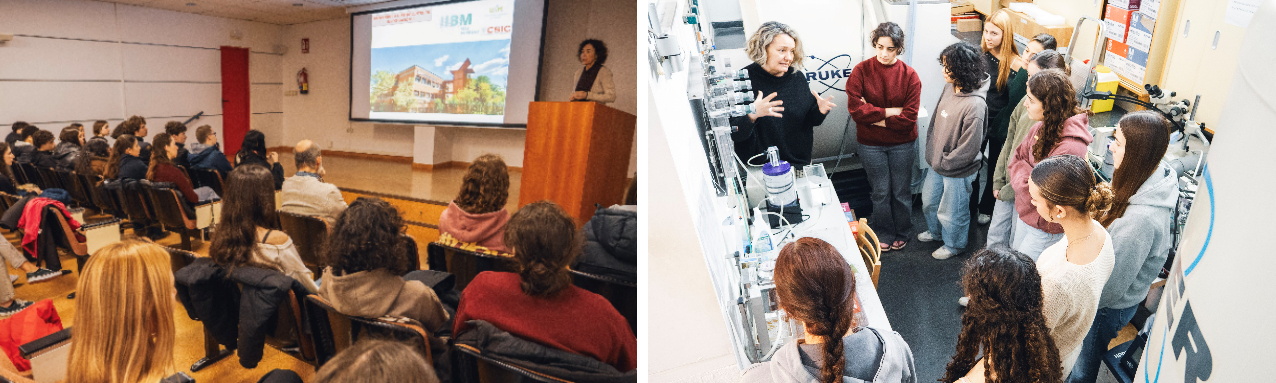
Among the highlights of this year’s edition was the traditional scientific tour of the IIBM, which allowed 11th-grade students from IES Jorge Manrique to learn firsthand how biomedical research is conducted. Under the title “Bioimaging techniques in biomedical research,” the visit was coordinated by Belén Peral, and Teresa Navarro and Patricia Sánchez, from the Servicio de RMN Biomédica Sebastián Cerdán, and Mónica Martín Belinchón and Bárbara Acosta, from the Servicio de Microscopía Óptica y Confocal, who showed students some of the imaging technologies most commonly used in biomedical research.
The program also included activities open to the institute itself. The Comité de Igualdad del IIBM organized the screening of the documentary Prometeas, a look at the role of women in science through film, followed by a brief discussion session held in the Salón de Actos Gabriella Morreale of the IIBM to share impressions and reflect on the presence of women in the scientific field.

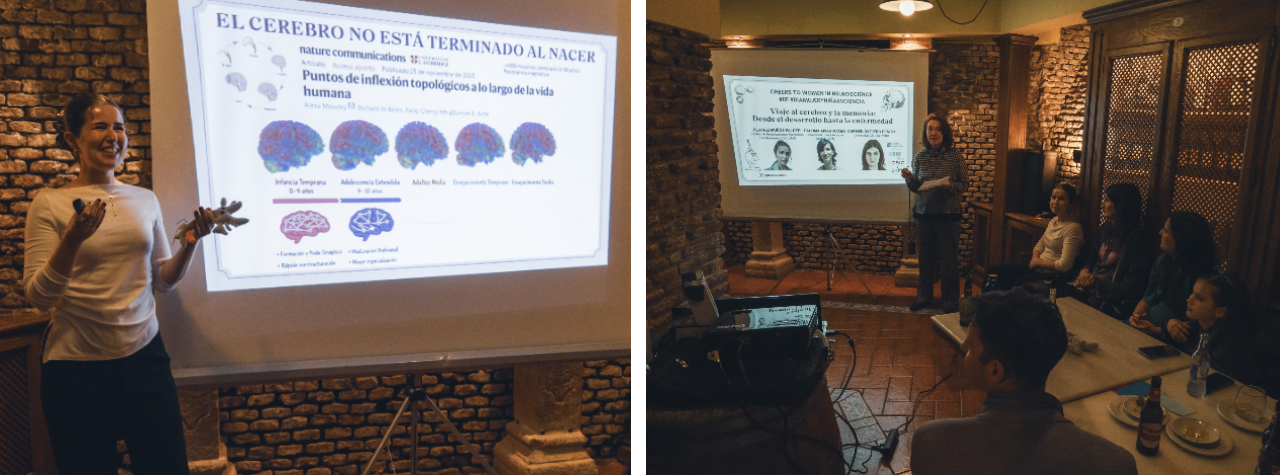
Outreach activities also moved beyond the laboratory to engage with society in different settings. Ana Guadaño, Soledad Bárez, and Beatriz Muñoz Falder organized a new edition of the event “Cheers to Women in Neuroscience,” held at the Mirador del Arco de Cuchilleros, in the heart of Madrid. Under the title “Journey to the brain and memory: from development to disease,” the researchers shared knowledge about neuroscience with the public in a close and participatory environment.
Likewise, Cristina Rodríguez Antona took part in the Sci Women Party event, organized by the Unidad de Cultura Científica y de la Innovación of the Universidad Rey Juan Carlos at its Móstoles campus. This initiative provided a participatory space for dialogue and reflection on the role of women in science, built from personal experiences and testimonies that help to make female role models visible, break stereotypes, and foster scientific vocations among girls and young women.
Talks and scientific workshops in educational centers once again became one of the pillars of 11F at the IIBM. Researchers from the institute visited schools and high schools to talk about health, the environment, cancer, neuroscience, and nutrition.
Thus, Pilar Santisteban delivered the talk “The invisible threat: how environmental pollutants, plastics, and microplastics affect our health” to high school students at IES Villablanca. Meanwhile, María Alieva gave the lecture “Rockets and microscopes: the legacy of women computers” at CEIP San Andrés in Colmenar Viejo, aimed at 5th-grade primary school students, bringing them closer to the history of the pioneers of computing and its connection to modern science. Isabel Lastres participated in the Congreso Investigadoras ODS held at IES Lope de Vega, where she delivered the talk “ALS under the microscope: advances and challenges,” bringing students closer to research on this neurodegenerative disease.
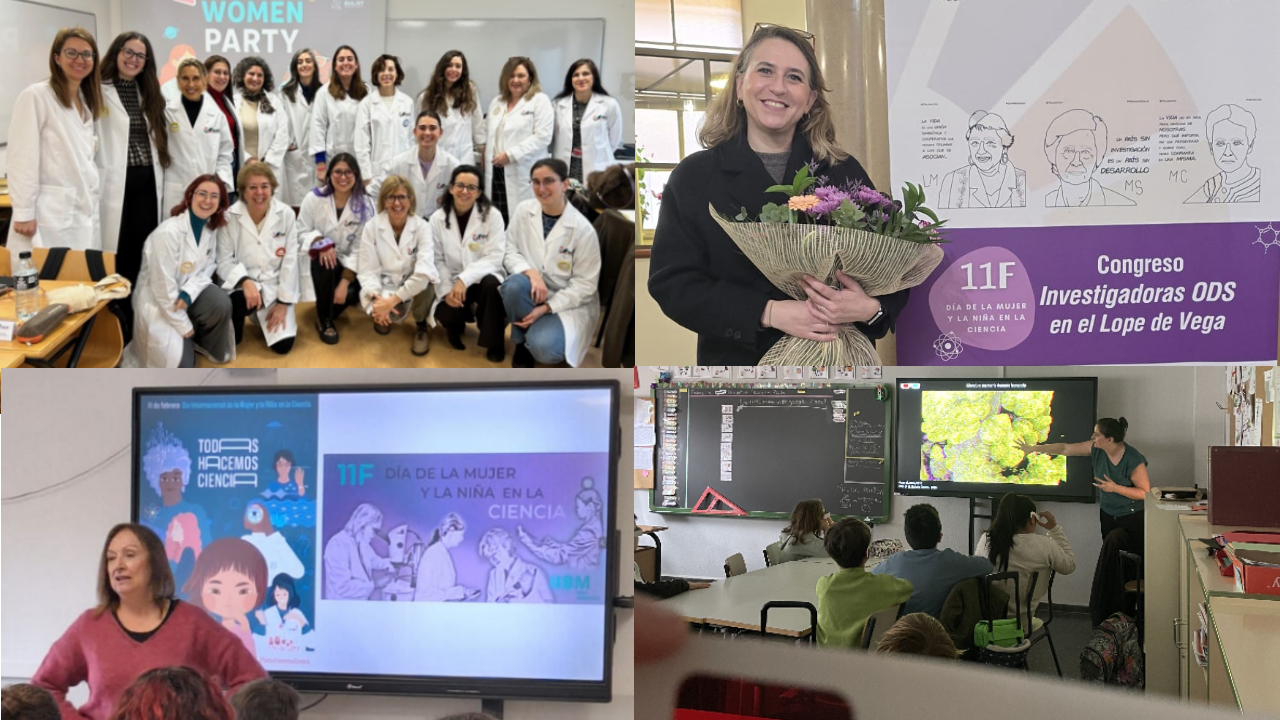
Marina Lasa also visited IES Profesor Domínguez Ortiz in Azuqueca de Henares (Guadalajara), where she shared with high school students the talk “From curiosity to the lab: the journey of a woman scientist,” in which she recounted her personal experience in scientific research.
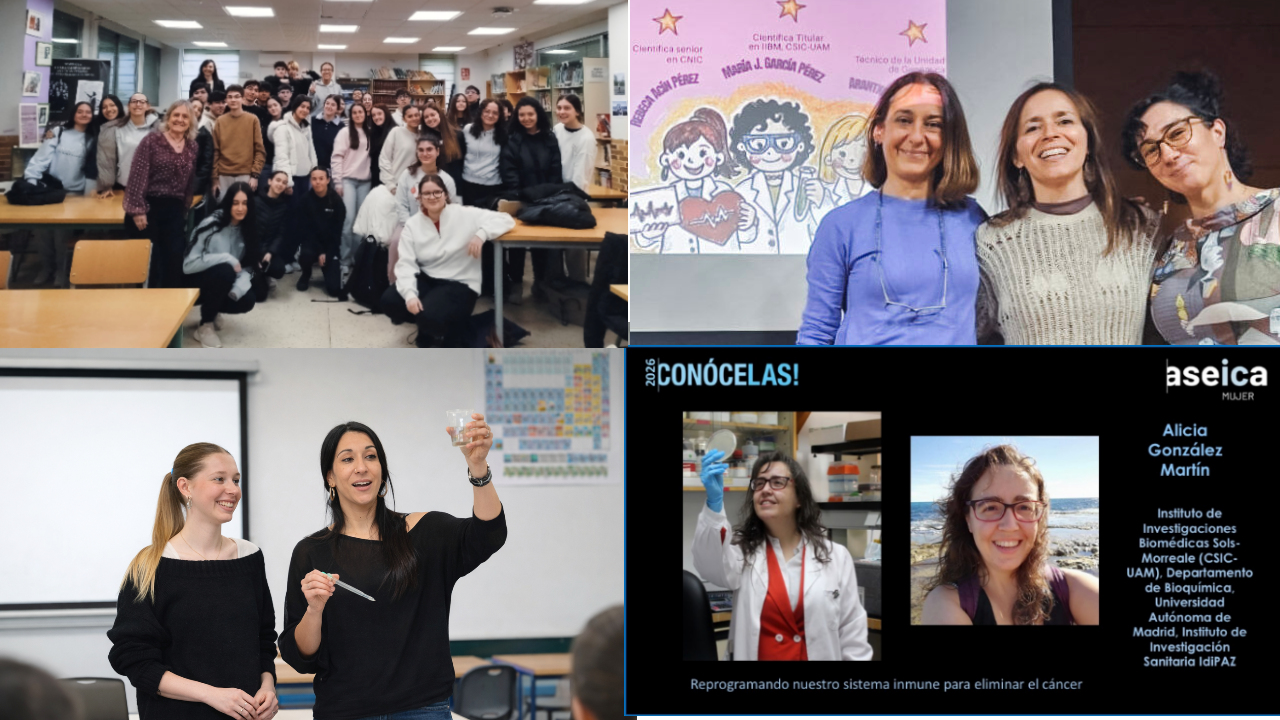
Younger students were also protagonists thanks to hands-on activities. Soledad Bárez and Isobel Dumont delivered the workshop “Take your DNA home!” at CEIP Amador de los Ríos, where 1st-, 3rd-, and 5th-grade primary school students carried out a simple experiment to extract and observe their own DNA.
Likewise, Alicia González Martín participated in the CONOCELAS 2026 initiative, organized by the Asociación Española de Investigación sobre el Cáncer (ASEICA), with the talk “Reprogramming our immune system to eliminate cancer,” delivered to 12th-grade students at IES Alonso Quesada in Las Palmas de Gran Canaria.
On the other hand, María J. García Pérez delivered the talk “Mothers of Science,” organized by the AMPA of CEIP Rabindranath Tagore and held at the Biblioteca Rafael Alberti, while Belén Peral gave the lecture “Healthy eating” to 11th-grade students at IES Villa de Vallecas.
With this extensive program, IIBM female scientists once again brought biomedical research closer to society, broke stereotypes, and paid tribute both to the women who currently lead scientific projects and to those who paved the way. Because science is built on talent, diversity, and vocation, and 11F remains an opportunity to remember it.