Outreach - u_comunicacion

Unit for Communication and Science Culture

IIBM Unit for Communication and Science Culture

Outreach Activities at the IIBM

The Unit of Communication and Scientific Culture (UCCC) at the IIBM coordinates and takes part throughout the year in a range of science outreach initiatives aimed at bringing biomedical research closer to society. These include:

  • European Researchers’ Night
  • Science in the Neighborhood Programme
  • Science and Technology Week
  • Training programmes: 4th year of Secondary Education + Company, Scientists in Training, Spanish Biology Olympiad
  • Europe Day
  • Ventu-Ciencia
  • Initiatives promoted within the IIBM
  • Participation in science outreach programmes on radio
  • Celebration of 11F – International Day of Women and Girls in Science
    ​​​​​​​

Activities promoted within the IIBM: BrainStorm Battles

The NeuroACTIVAS team at the IIBM, within the framework of the Neurological Diseases Programme, organized BrainStorm Battles, a scientific-social event focused on the analysis and discussion of scientific articles. Through a dynamic and participatory format, teams explored different approaches, hypotheses and interpretations, fostering critical thinking, the exchange of ideas and teamwork.


​​​​​​​

Participation of the IIBM in Europe Day 2026

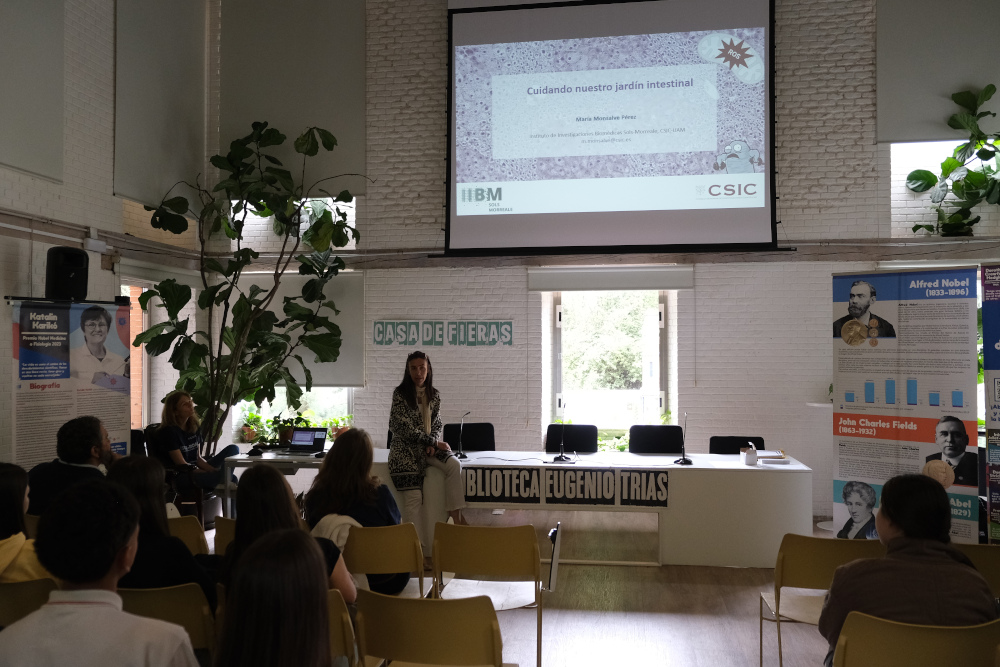
In 2026, CSIC centers on the Cantoblanco campus will celebrate Europe Day at the Eugenio Trías Public Library, located in the former Casa de Fieras in El Retiro Park. This is a two-hour activity aimed at high school students. It will take place on May 6, 7, and 8 (Wednesday, Thursday, and Friday), with two sessions each day: from 9:30 to 11:30 a.m., and from 12:00 to 2:00 p.m.

As every year, the event includes a one-hour meeting with researchers working within the European framework, with the aim of showcasing the research we carry out in a European context and highlighting the opportunities that the European Union offers to participate in, promote, and fund research across various fields (biology, materials science, chemistry, physics, etc.).

​​​​​​​
​​Within this initiative, the Instituto de Investigaciones Biomédicas Sols-Morreale (IIBM) will be represented on May 7 by María Monsalve, who will deliver the outreach talk “Caring for Our Intestinal Garden” to 63 students from the 1st year of Bachillerato and 4th year of ESO at Colegio SEI La Merced. María Monsalve is head of the research group “Mitochondrial Function in Health and Disease” at the IIBM. She and Ángela M. Valverde are participants in the European project (EU270756_1) HORIZON-EIC-2023-PATHFINDERCHALLENGES, funded by the European Union under the Horizon Europe programme, entitled “Linking Intestinal Bacteria and Host Metabolism to Tackle Type 2 Diabetes with Novel Food”. In this context, the talk will address the role of the intestinal microbiota and the importance of maintaining its balance to help prevent disease.

During the second hour of the activity, students will take part in a scavenger hunt focused on Nobel Prize-winning women scientists: our Escape Road. This activity is based on an exhibition about researchers who have been awarded the Nobel Prize in scientific disciplines, or their equivalents in mathematics (the Abel Prize and the Fields Medal). Students will be divided into teams that will compete by answering questions related to the exhibition. There will, of course, be prizes for the winning team. The activity will also highlight other outstanding women researchers whose contributions were not properly recognized.

Europe Day

May 9 marks Europe Day, commemorating the anniversary of the historic “Schuman Declaration.” On this date in 1950, French Foreign Minister Robert Schuman proposed the creation of a European Coal and Steel Community (ECSC), whose member states would pool the production of these materials. Established in 1951 by France, West Germany, Italy, the Netherlands, Belgium, and Luxembourg, the ECSC was the first in a series of supranational institutions that would eventually become what is now the European Union (EU).

Who we are

This activity is organized by CSIC centers located on the Cantoblanco campus of the Universidad Autónoma de Madrid: Instituto de Ciencia de Materiales de Madrid (ICMM) (coordinator), Instituto de Investigaciones Biomédicas Sols-Morreale (IIBM), Instituto de Catálisis y Petroleoquímica (ICP), Centro Nacional de Biotecnología (CNB), Instituto de Investigación en Ciencias de la Alimentación (CIAL), Instituto de Cerámica y Vidrio (ICV), Instituto de Ciencias Matemáticas (ICMAT), Instituto de Física Teórica (IFT), Instituto de Micro y Nanotecnología (IMN), and Centro de Biología Molecular (CBM).

Pint of Science – Science Outreach in Bars

The Instituto de Investigaciones Biomédicas Sols-Morreale (IIBM) took part this year in the international science outreach festival Pint of Science, an initiative that brings science closer to society in a relaxed and engaging format by hosting scientific talks in bars across the city. On May 18, our colleague Miguel Sánchez Álvarez (Cellular Compartmentalization, Homeostasis and Inflammation group) participated in this edition with the talk “Cell Renovations: Making the Most of Space”, held at Citynizer Plaza in central Madrid.


​​​​The event was very well received, filling the venue and creating a highly interactive atmosphere throughout the session. According to the researcher, the experience was especially rewarding both because of the audience’s interest and the informal setting, which encourages direct dialogue with the public.

This participation builds on previous IIBM contributions to the festival, such as the talk given by Gemma Domínguez Muñoz (Biomarkers in Colorectal Cancer: Early Diagnosis and Therapeutic Targets group) in 2023 at La Lata Cascorro bar, entitled “Trojan Horses in Tumor Dissemination”.

Without a doubt, initiatives like this reinforce IIBM’s commitment to science communication and to strengthening the connection between research and society, bringing science into accessible and engaging settings for younger audiences.

CSIC Scientific Lectures Catalogue

This Catalogue is aimed at the Education System of the Community of Madrid, primarily for Primary, Secondary and Baccalaureate students. The speakers are drawn from the CSIC scientific community at all levels — from research professors to pre-doctoral students. The Catalogue is coordinated by the CSIC Delegation in the Community of Madrid, and the IIBM has long been involved in this endeavor.

For the academic years 2025–26 and 2026–27, the sixth edition of the CSIC Scientific Lectures Catalogue was published (October 2025). This new edition includes over three hundred lectures covering all areas of knowledge, primarily intended for the Education System of the Community of Madrid, though they may also be scheduled in museums, libraries, and other interested cultural entities.

The IIBM continues its active participation in this edition: researchers and technical staff from the Institute offer outreach lectures tailored to various educational levels, fostering a direct connection between the scientific community and schools.

In this edition, the following IIBM researchers are participating: Alberto Bartolomé Herranz, Lisardo Boscá Gomar, Sandra Franco Caspueñas, Ana Guadaño Ferraz, Manuel Izquierdo Pastor, Ángela Martínez Valverde, María Monsalve Pérez, Silvia Murillo Cuesta, Laura Notario Muñoz, Jesús Pacheco Torres, Belén Peral Fuentes, and Pilar Santisteban Sanz.

International Day for Women and Girls in Science

The International Day of Women and Girls in Science is celebrated every 11 February, since it was established by the United Nations in 2015 to recognise the contribution of women to scientific progress and to promote scientific vocations among young girls.

At the IIBM, this day is celebrated each year with strong involvement from our researchers, who dedicate their time and effort to outreach activities aimed at audiences of all ages.

In 2023, twenty-four members of the institute, belonging to thirteen research groups, organised nineteen activities, including children’s workshops, lectures, “wine and neuroscience” sessions, interviews, and social-media content, far surpassing the previous year’s participation. READ MORE

In 2024, under the slogan “We all do science”, the IIBM once again took part in this celebration with an extensive programme: talks for secondary-school and high-school students, workshops in primary schools, school visits to the institute, debates, and the now traditional Escape-Road activity. READ MORE

In 2025, the IIBM continued to strengthen its commitment to this initiative with an even broader and more structured programme. The activities included talks, workshops, visits, and meetings with women researchers in schools and high schools, as well as participation in a joint event with other CSIC centres on the Cantoblanco Campus. READ MORE

​​​​​​​In 2026, the IIBM once again joined the International Day of Women and Girls in Science with a wide-ranging and dynamic program that involved numerous women researchers in activities aimed at students and the general public. The initiative combined events both within and beyond the institute, including the traditional scientific tour of the IIBM focused on bioimaging techniques, the screening of the documentary “Prometeas” followed by a discussion session, and outreach events in public spaces such as “Cheers to Women in Neuroscience”. In addition, researchers brought science to schools through talks and workshops on health, cancer, environmental issues, neuroscience, and nutrition, while also contributing to participatory initiatives such as Sci Women Party and CONÓCELAS. This extensive program once again highlighted the IIBM’s commitment to showcasing female role models in science, breaking stereotypes, and fostering scientific vocations among girls and young students. READ MORE

4th ESO+Empresa Programme

The 4th ESO+Empresa programme, promoted by the Community of Madrid, brings Secondary School students closer to the professional world through one-week placements in companies and scientific institutions, including CSIC centres.

At the IIBM, several research groups participate annually, offering students a first-hand experience of biomedical research.

  • 2022: Two research groups (María Monsalve and Ángela Martínez Valverde) hosted three students.
  • 2023: Four research groups and services (Isabel Sánchez, María Monsalve, Ángela Martínez-Valverde and Teresa Navarro – Sebastián Cerdán Biomedical NMR Service) welcomed seven students.
  • 2024: Several IIBM units and two Scientific-Technical Services hosted 13 students (all female), making 2024 the year with the highest number of participants at the Institute.​​​​​​
  • 2025: The IIBM again took part by hosting eight students across four research groups (Guillermo de Cárcer, Ángela Martínez Valverde, José L. Orgaz and Isabel Sánchez). During their placement, students learned about the institute’s organisation, visited laboratories and scientific-technical services, and carried out basic molecular and cellular biology practices.

In 2026, IIBM hosted six students from three different secundary schools who carried out their training placement by joining two research groups (Alain de Solis and Pilar López-Larrubia). The experience also included hands-on training in several of IIBM’s scientific-technical facilities, where they learned how key equipment and techniques used in biomedical research operate. These included the Genomics Core Facility; the Optical & Confocal Microscopy Facility; Biomedical NMR Sebastián Cerdán; the Histology Facility; and the Animal Facility.

The IIBM remains committed to this programme, which continues to inspire scientific vocations and bring young students closer to the everyday work of biomedical research.

Scientists in Practice

The Científic@s en Prácticas program, promoted by the Consejo Superior de Investigaciones Científicas (CSIC) and the Asociación Española para el Avance de la Ciencia (AEAC), offers students in the thrird year of Spanish secondary education (3.º ESO) and the Curricular Diversification Program (PDC) from vulnerable backgrounds the opportunity to gain first-hand insight into scientific research through activities at research centers.

The IIBM has participated in the program since its inception. During its pilot phase, Dr. María Monsalve collaborated with IES Miguel Delibes (Ciudad Lineal) and hosted two students in her laboratory. Since then, several research groups at the Institute have continued to take part in the program, hosting students from different schools in the Community of Madrid for one-week placements and introducing them to the day-to-day work of biomedical research. In the 2022–23 and 2023–24 included the groups of María Monsalve, Soledad Bárez, Juan M. Zapata, and Ángela Martínez-Valverde, while in 2024–25, the teams of Ángela Martínez-Valverde, Juan M. Zapata, and María Monsalve took part again.

In the 2023–24 academic year, the educational program received first prize in the Outreach Project category at the second edition of the CSIC Awards for Science Outreach and Citizen Science.

In the 2025–26 edition, the IIBM expanded its participation to the program's different stages: three outreach talks were given, two scientific tours of the IIBM were organized for students from two schools, and the program culminated in a one-week training placement in the laboratories of Juan M. Zapata, Ángela Martínez-Valverde, María Monsalve, and Alain de Solis, where eight students had the opportunity to take part in different activities and experience biomedical research from the inside (Read the full article HERE).

European Researchers' Night in Madrid

European Researchers’ Night is a large-scale initiative that brings science closer to society through scientific and cultural activities designed to showcase researchers’ work and its impact on people’s lives. It is celebrated simultaneously in more than 350 cities across Europe.

The CSIC centres on the Cantoblanco Campus of the Universidad Autónoma de Madrid jointly organise a wide range of activities for this annual event. The IIBM took part for the first time in 2024, when the event was held on 27 September at the Espacio Fundación Telefónica with three workshops and two science monologues. The workshop facilitators were Cristina Peña, Soledad Bárez and Belén Peral, and the monologue performers were David Albandea, Arturo González de la Aleja and María Monsalve.

In 2025, the event was again held at the Espacio Fundación Telefónica, on 26 September, consolidating IIBM’s participation in this European initiative. That year the institute presented five scientific activities, organised by research and technical staff, which attracted participants of all ages. Offerings included biology and biochemistry workshops, experimental demonstrations, science storytimes and interactive activities designed to provide hands-on scientific experiences.

In addition, the IIBM took part in morning activities for school groups, contributed to the public science fair and joined the Escape Road, a treasure-hunt style activity focused on the lives and contributions of notable women scientists. The commitment of volunteer staff was essential to the event’s success, supporting organisation, visitor guidance and activity facilitation.

IIBM’s participation in European Researchers’ Night reflects the institute’s commitment to science outreach and to bringing biomedical research closer to society. Year after year, the number of researchers, doctoral students and technical staff involved continues to grow, demonstrating the institute’s dedication to fostering scientific vocations and creating spaces for dialogue between science and citizens. READ MORE

SPANISH BIOLOGY OLYMPIAD

The Spanish Biology Olympiad is held annually and is open to upper-secondary school students  (2.º Bachillerato) from across Spain. The highest-ranked students go on to compete in the national round, and among the awards they receive is the opportunity to spend one week in a research laboratory in the field of Biology and Biomedicine.

The IIBM has participated in the program since 2022, hosting students from different regions of Spain in the laboratories of several research groups. In the 2022 and 2023 editions, the groups of Juan M. Zapata, Ángela Martínez-Valverde, and José Orgaz hosted four students, while in 2024 the groups of Pilar López Larrubia and Luis del Peso took part. In 2025, the groups of Juan M. Zapata and Manuel Izquierdo hosted two students, who had the opportunity to gain first-hand insight into the researchers’ work (READ MORE).

In 2026, the IIBM hosted three students recognized in the 21st Spanish Biology Olympiad, held in Santander. From June 29 to July 3, they completed research placements in the groups of Ángela Martínez-Valverde, Manuel Izquierdo and Juan M. Zapata, where they learned basic and advanced techniques in molecular biology, immunology, and microscopy, gaining hands-on research experience that strengthened their motivation to pursue future scientific careers (READ THE ARTICLE HERE).

SCIENCE AND TECHNOLOGY WEEK

Every year in November, the doors of all research centres across the country open to commemorate Science and Technology Week. The CSIC encourages its institutes to organise informative activities for non-scientist in order to promote interest of our society in science.

A large number of IIBM researchers, both from the scientific and technical services and from the research groups, took part in Science and Technology Week 2022. Eight activities, including scientific workshops, conferences and scientific tours, brought the science of the IIBM closer to our citizens, both adults and young people. Although we organized more events focused on school students, our mission is to stimulate scientific vocations at all levels of our society.

In 2023, during the Science and Technology Week, the IIBM offered seven activities between 2 and 17 November, including three visits to the institute, one scientific workshop and three talks. The institute’s research staff and technical personnel actively contributed to organising scientific tours, workshops and talks aimed at vocational training students, secondary and high-school pupils, and the general public.

In 2024, the IIBM once again participated actively in the Science and Technology Week, joining the 24th edition of this major national outreach event. Our institute organized seven activities —including talks, workshops, and scientific tours— which involved researchers and technical staff from several scientific-technical services and research groups. During the two weeks of the event, we welcomed numerous educational centres from the Community of Madrid and from Castellón de la Plana, as well as adult visitors interested in the conferences on Alzheimer’s and Parkinson’s disease.

In 2025, the IIBM actively contributed to the Science and Technology Week through a programme designed to introduce students to the daily practice of biomedical research. The institute offered five activities—three scientific tours and two workshops—made possible by the involvement of researchers and technical staff from several research groups and scientific-technical services at the IIBM. Throughout the event, we welcomed 130 students from different educational centers in the Community of Madrid. The scientific tours, once again in high demand, allowed visiting groups to learn about bioimaging techniques, auditory exploration, and the daily work carried out in a biomedical research laboratory. The workshops were also very well received: a new edition of the activity dedicated to the model Dictyostelium discoideum was held, and a second workshop was introduced, focused on basic cell and molecular biology techniques.

Once again, the IIBM community demonstrated its commitment to science outreach and to inspiring scientific vocations among pre-university students.

Rare Disease Day

Since 2008, World Rare Disease Day has been commemorated on 28 February to raise awareness in the society of the existence of rare diseases, and to make people suffering from these rare pathologies more visible, so that they can receive a diagnosis as soon as possible and thus lead a better life.

At the IIBM, all members of the Rare Diseases Department, which includes eleven groups working on rare diseases, met for the first time on 28 February 2023 in order to take a "family" photo and tell us about their research. READ MORE

​​​​​​​In February 2024, to mark Rare Disease Day, the I Rare Diseases Meeting was held at the IIBM thanks to the joint efforts of several members of the Department of Rare Diseases. Numerous researchers, patient associations and representatives of major institutions such as the CSIC and the Community of Madrid were invited. READ MORE

​​​​​​​​​​​​Given the success of the first meeting, in 2025 the IIBM once again marked Rare Disease Day with the celebration of the II Rare Diseases Meeting, in order to continue strengthening the institute’s commitment to research into these conditions. Throughout the meeting, different rare diseases studied by IIBM research groups were addressed, scientific advances and clinical experiences were shared, and clinicians, patients and family members were given a voice, highlighting the need to promote early diagnosis, collaborative research and social support. This initiative consolidated the IIBM as a meeting point between science, medicine and society in the field of rare diseases. READ MORE

In 2026, the IIBM held the III Rare Diseases Meeting, focused on “Therapeutic Approaches”, reinforcing its commitment to advancing from basic knowledge to clinical application. Throughout the event, innovative strategies under development were presented —including gene and cell therapies, precision medicine, and the use of biomaterials— alongside examples of approved treatments that are already transforming patients’ lives. The workshop also featured the active participation of patient associations, highlighting their key role in driving research and enabling the arrival of new therapies. This initiative further consolidates the IIBM as a forum for exchange between science, clinical practice, and society, aimed at addressing unmet medical needs. READ MORE