- A study led by Dr. Margarita Díaz-Guerra and Dr. Isabel Varela-Nieto develops a neuroprotective strategy based on the MTFL457 peptide that preserves cochlear synapses and auditory function in preclinical models of hearing damage
The research groups "Protective peptides against acute and chronic damage of the nervous system" and "Auditory Neurobiology and Myelinopathies", directed respectively by Drs. Margarita Díaz-Guerra and Isabel Varela-Nieto from the Instituto de Investigaciones Biomédicas Sols-Morreale (IIBM), CSIC-UAM, have published in Molecular Medicine a highly promising breakthrough for the treatment of deafness. This study demonstrates the neuroprotective potential of peptide MTFL457 in noise-induced hearing loss, driven by the stabilization of BDNF/TrkB-mediated neurotrophic support, which is essential for preserving cochlear anatomy and function.
Noise-induced hearing loss is a major global health issue, currently standing as the second leading cause of deafness worldwide. Despite its severe socioeconomic impact and its toll on the quality of life of those affected, there are still no effective pharmacological treatments to fight against it. One of the earliest events triggered by noise in the inner ear is excitotoxicity, a massive and harmful release of the neurotransmitter glutamate that destroys the synapses connecting cochlear hair cells and the auditory neurons, in a pathological process known as cochlear synaptopathy.
"As we demonstrated in previous studies, excitotoxic damage, such as that occurring during a stroke, causes the degradation of the neurotrophin receptor TrkB-FL (which features tyrosine kinase activity), thereby disrupting key neuronal survival signals mediated by the neurotrophic factor BDNF," explains Dr. Margarita Díaz-Guerra. In the cochlea, noise overexposure and the resulting excitotoxicity also compromise the structural integrity of the TrkB-FL receptor. Consequently, many traditional ear-protection therapies relying on neurotrophins could be compromised and result ineffective.
To overcome this obstacle, the team evaluated the effects of a peptide named MTFL457, which contains a short sequence of TrkB-FL and is capable of interfering with the receptor degradation induced by cerebral ischemia. "The primary goal of this study was to determine whether, as was previously demonstrated in preclinical stroke models, this peptide could prevent TrkB-FL receptor degradation in the cochlea and promote the survival of auditory neurons under damage conditions, thereby exerting a neuroprotective effect against noise-induced hearing loss," highlights Dr. Elena Torres-Campos, the study’s first author, whose doctoral thesis served as the foundation for developing this new therapeutic strategy.
Upon testing the MTFL457 peptide in ex vivo models (cochlear explants) and in vivo, the researchers discovered that it has an excellent capacity for cochlear penetration and distribution. This demonstrated that, following systemic administration, MTFL457 was able to successfully cross the blood-labyrinth barrier, historically one of the greatest hurdles in developing drugs to treat the inner ear.
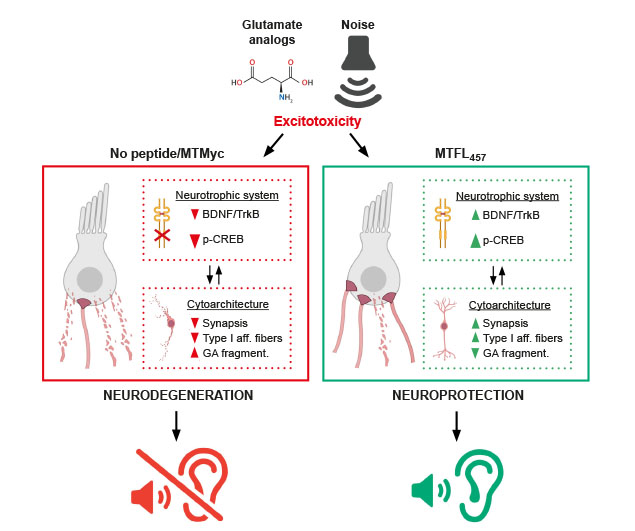
Graphical abstract of the effect of peptide MTFL457 against excitotoxicity induced by glutamate analogs and noise overexposure.
In addition, the biological assays yielded highly promising results. In cochlear explants subjected to excitotoxicity, pre-treatment with MTFL457 prevented the decrease of TrkB-FL receptor levels, thereby preserving pro-survival signaling pathways and resulting in a drastic reduction of neurodegenerative damage and cochlear synaptopathy. This protective effect on cochlear synapses was also observed when the peptide was administered after the excitotoxic damage had already initiated, a result that establishes a highly relevant therapeutic window for synaptic repair.
Nonetheless, the most promising outcome was obtained in an in vivo model of noise-induced hearing loss. Although male and female mice exhibited biological differences in their susceptibility to noise damage, MTFL457 administration successfully preserved auditory function and maintained the integrity of cochlear synapses in both sexes, even though the protection attained showed slight variations between them.
"The importance of this study relays on the fact that we have developed a novel and highly efficient therapeutic strategy against noise-induced hearing loss, which has the potential to be used for treating other types of deafness that also involve excitotoxicity," concludes Dr. Isabel Varela-Nieto.
The study was supported and funded by an Industrial Doctorate project (IND2020/BMD-17454) from the Comunidad de Madrid, in collaboration with Alodia Farmacéutica S.L., and the Agencia Estatal de Investigación (PID2020-115274RB-I00 and PID2022-137710OB-I00).
Article reference:
Elena Torres-Campos, Isabel Varela-Nieto y Margarita Díaz-Guerra. Neuroprotective potential of a TrkB-FL-derived cell-penetrating peptide in cochlear synaptopathy and noise-induced hearing loss. Molecular Medicine, 2026. DOI: https://doi.org/10.1186/s10020-026-01539-9
Cover image. Cochlear synapses between inner hair cells (MyoVIIa, blue) and spiral ganglion neurons, showing colocalization between a marker of synaptic vesicles (CtBP2, green) and a marker of the postsynaptic density (PSD-95, red).