The response to chemotherapy can vary depending on the age at which colorectal cancer is diagnosed. A study led by the Colon Cancer: Organoids, Microenvironment and Vitamin D research group at the Sols-Morreale Institute for Biomedical Research (IIBM), a joint center of the Spanish National Research Council (CSIC) and the Autonomous University of Madrid (UAM), has identified differences in sensitivity to certain drugs between early-onset tumors, diagnosed before the age of 50, and those diagnosed at older ages. The findings also show that calcitriol, the most active form of vitamin D, can modify the response to some treatments differently depending on age.
The study, published in International Journal of Biological Sciences, was conducted by researchers affiliated with the Cancer area of the Spanish Biomedical Research Network (CIBERONC), in collaboration with Hospital Universitario La Paz and the Fundación Jiménez Díaz, as well as researchers from other CIBERONC groups and the Respiratory Diseases area (CIBERES).
Organoids to study treatment response
The incidence of early-onset colorectal cancer (EO-CRC) is increasing worldwide, although its causes are not yet fully understood. These tumors may have different characteristics from those diagnosed after the age of 50 (late-onset colorectal cancer, LO-CRC), yet the treatments used are essentially the same regardless of the patient's age.
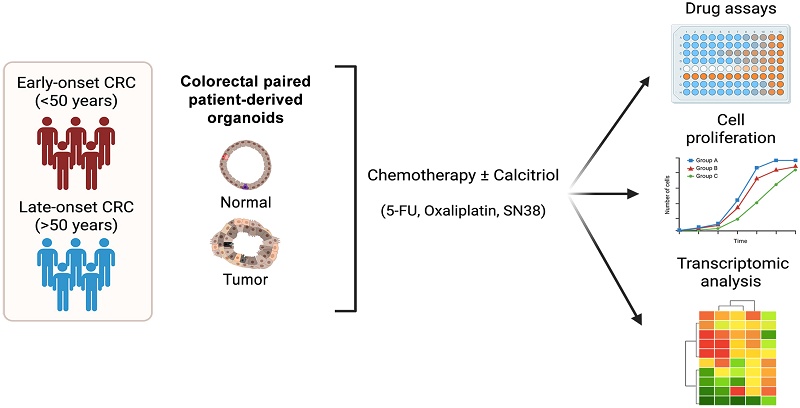
To investigate whether age is associated with differences in chemotherapy response, the team used organoids derived from normal colonic and tumor tissue from the same patient. These three-dimensional models, generated from patient samples, allow researchers to study the responses of both tissue types to different treatments in the laboratory.
The researchers analyzed sensitivity to three drugs used to treat colorectal cancer: 5-fluorouracil, oxaliplatin, and SN38, the active metabolite of irinotecan. The results revealed substantial variability between patients. Overall, normal organoids were more resistant than tumor organoids to 5-fluorouracil and oxaliplatin in both early-onset and late-onset colorectal cancer. However, sensitivity to SN38 differed according to age: the therapeutic window—that is, the range in which a drug preferentially affects tumor tissue over healthy tissue—was maintained in organoids from patients with late-onset colorectal cancer, but not in those from patients with early-onset disease.
“These findings show that chemotherapy response varies between patients and that age may influence differences in sensitivity between tumor and normal tissue,” explain Asunción Fernández-Barral and Antonio Barbáchano, the study's coordinators.
Calcitriol modifies the response to certain drugs
The team also investigated the effect of calcitriol on chemotherapy response. This compound reduced the toxicity of 5-fluorouracil and SN38 in normal organoids, regardless of patient age. In tumor organoids, however, this protective effect was observed only in those derived from patients with early-onset colorectal cancer.
As a result, in organoids from patients with late-onset colorectal cancer, calcitriol widened the therapeutic window of both drugs by protecting normal tissue to a greater extent than tumor tissue. Molecular analyses linked these effects to the antiproliferative activity of calcitriol and changes in the expression of genes involved in drug metabolism.
Overall, the findings reveal age-related differences in the response to certain treatments and open new avenues for investigating whether vitamin D may help reduce the side effects of chemotherapy. However, these results were obtained using laboratory models, and further studies are needed to determine whether the same effects occur in patients.
Reference article: Fernández-Barral A, Barbáchano A, Rodríguez-Marrero S, et al. “Calcitriol Modulates Age-dependent Drug Response in Paired Patient-derived Normal and Tumor Colorectal Organoids”. International Journal of Biological Sciences. 2026; 22(13):7003-7017. doi: 10.7150/ijbs.131639.