Two research groups from the Instituto de Investigaciones Biomédicas Sols-Morreale (IIBM) CSIC-UAM), led by Gema Moreno-Bueno and Isabel Lastres-Becker —principal investigator and corresponding author of the study— have published in the Journal of Biomedical Science the study entitled “GASDERMIN D-mediated pyroptosis as a therapeutic target in TAU-dependent frontotemporal dementia mouse model”, in which they identify a new inflammatory mechanism involved in neurodegenerative diseases associated with the TAU protein, such as Alzheimer’s disease and frontotemporal dementia (FTD).
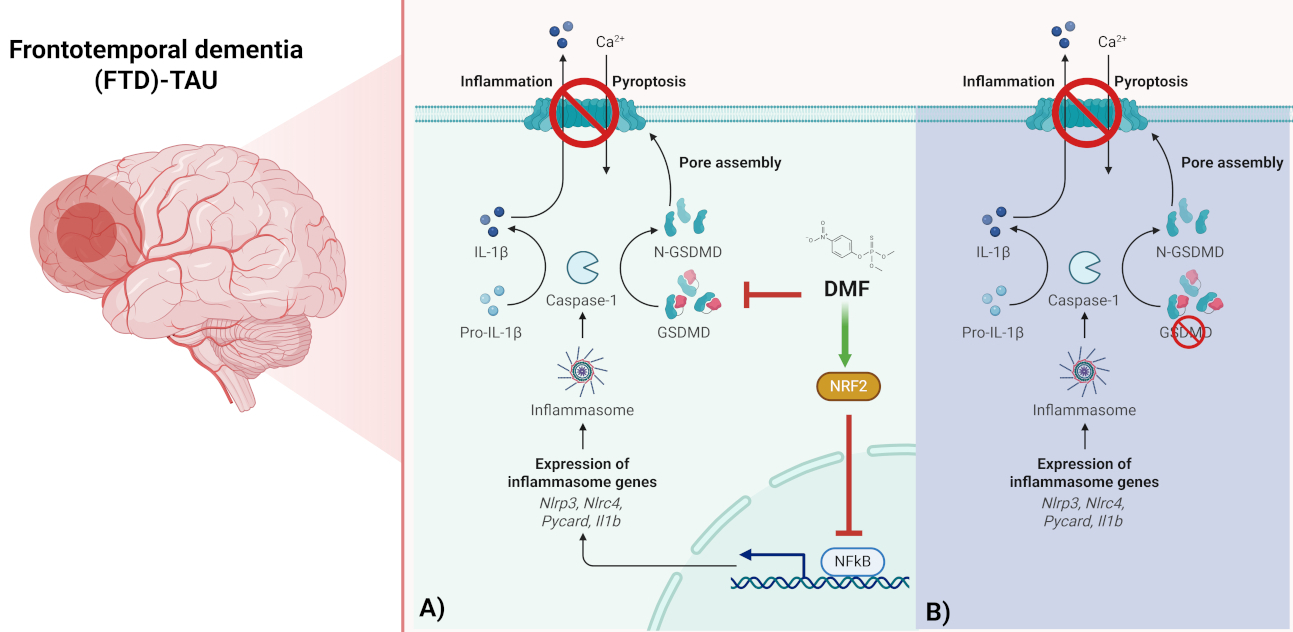
The study shows that pathological TAU accumulation strongly activates pyroptosis, an inflammatory form of cell death, in the hippocampus, a brain region essential for memory. This activation triggers brain inflammation and loss of synaptic plasticity. The process depends on the executor protein GASDERMIN-D (GSDMD), whose activation promotes the release of pro-inflammatory molecules.
The results also show that genetic deletion of GSDMD reduces TAU-induced inflammation. However, unexpectedly, it also worsens synaptic function, suggesting that this inflammatory mediator plays a dual and complex role in the brain.
The work also highlights the therapeutic potential of dimethyl fumarate (DMF), a drug already approved for the treatment of multiple sclerosis. In animal models, this compound was able to block pyroptosis, reduce neuroinflammation and restore key markers of neuronal plasticity, showing both preventive and neuroprotective effects.
Overall, these findings open new perspectives for the development of therapeutic strategies aimed at modulating pyroptosis and inflammation in tauopathies, a group of neurodegenerative diseases that currently lack effective treatments.